
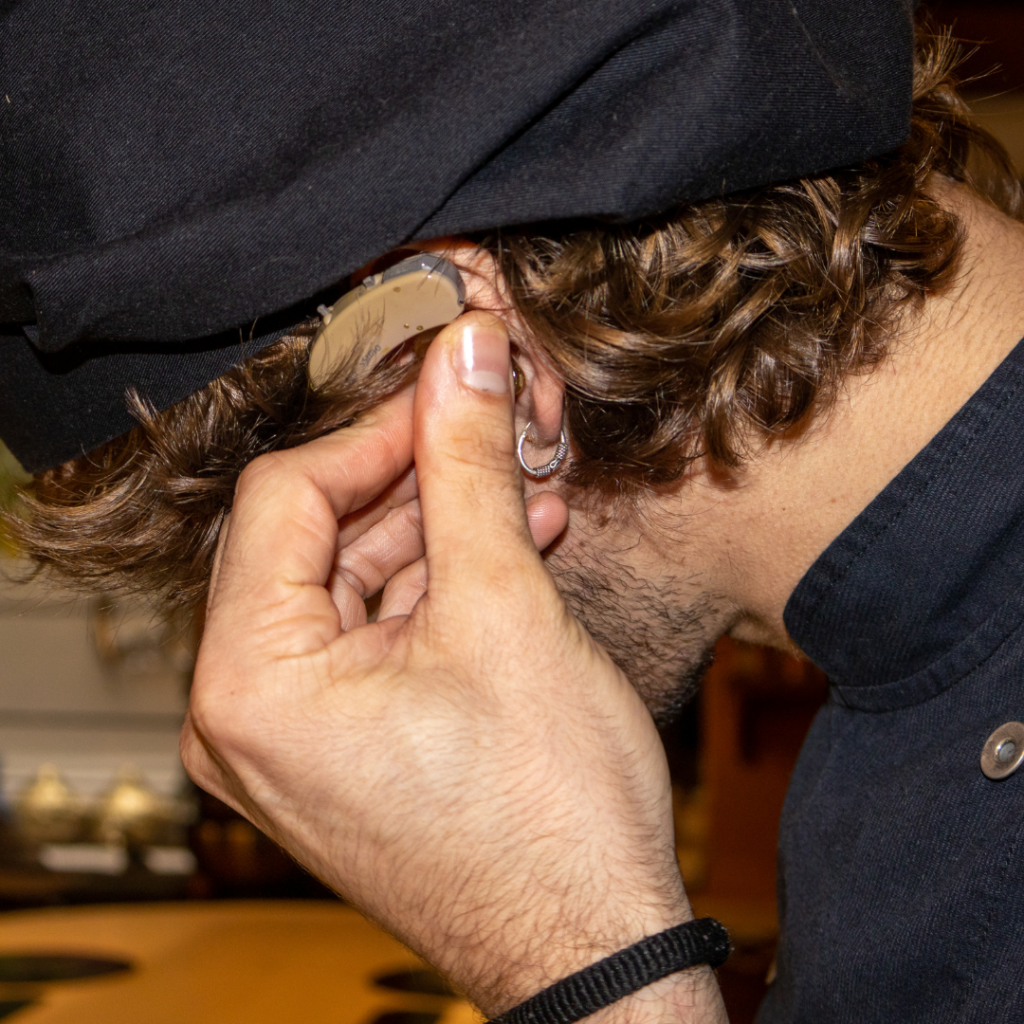
Maintaining dinner dialogue proves demanding when chaotic ambient noise strains your concentration and hearing. We perform comprehensive diagnostic assessments to evaluate hearing in quiet rooms and challenging acoustic spaces to identify functional deficits. When we isolate the root mechanism behind your difficult hearing, we guide you toward customized communication solutions.
Explaining Normal Quiet Hearing Versus Restaurant Listening Fatigue
A tranquil environment produces a beneficial signal-to-noise ratio where spoken dialogue easily overpowers weak ambient noise. Restaurants create the opposite situation. Multiple voices, music, kitchen noise, and reverberation overlap with speech, forcing the ears and brain to work harder to separate the person you want to hear.
This symptom pattern often reflects underlying high-frequency hearing loss, central processing dysfunction, or physiological aging of the auditory nerve. Dim lighting, physical tiredness, conversational distance, and divided attention exacerbate these listening deficits. It is common to display normal baseline audibility on conventional hearing tests while failing comprehensive speech-in-noise testing. Communication breakdowns in loud restaurants should be professionally assessed even if one-on-one listening feels uncompromised.
Diagnosing High-Frequency Hearing Loss and Clarity Issues
Our diagnostic process starts with a detailed case history reviewing problematic listening scenarios, occupational noise exposure, tinnitus, ototoxic medications, and familial genetics.
Pure-tone audiometric evaluations measure the absolute quietest sounds audible across specific octave frequencies using air and bone conduction. High-frequency loss often creates an audiogram pattern in which thresholds become poorer as pitches rise. Comprehensive evaluations frequently include impedance tympanometry to examine middle-ear function and recorded word-recognition testing to measure speech understanding.
A quiet sound booth cannot replicate complex dining room acoustics, which makes clinical speech-in-noise testing especially informative. This diagnostic protocol measures your capacity to understand target words or sentences against progressively louder multi-talker babble. Together, these audiological findings indicate whether the issue involves sound audibility, speech intelligibility, noise-processing dysfunction, or multiple compounding factors.
Understanding Auditory Processing Disorders in Noisy Environments
An auditory processing disorder affects how the central auditory nervous system interprets sound. A patient’s ears may demonstrate normal pure-tone sensitivity, but their central processing system struggles to separate background babble, distinguish consonant sounds, or follow swift discussions. We prioritize assessing peripheral auditory acuity before recommending an in-depth central auditory-processing assessment or external medical referrals.
Behavioral Strategies for Hearing Clearly in Loud Venues
Strategic behavioral modifications can substantially improve the auditory signal reaching your ears while maximizing supportive visual cues. When planning to dine out, select restaurants with calmer atmospheres or arrange reservations during off-peak hours. Settings constructed with comfortable booths, acoustic ceiling panels, drapery, and carpeted walkways facilitate easier communication than open venues with concrete and glass.
While seated at the restaurant:
- Ask host staff for a quiet table distanced from kitchen traffic, bar noise, audio speakers, and loud group tables.
- Situate yourself with a structural wall behind you to minimize distracting ambient noise from behind.
- Ensure you sit directly across from speaking partners in an area with sufficient illumination for visual lip-reading.
- Keep the distance between speakers as short as comfortably possible.
- Orient your stronger ear toward the key person you want to follow in conversation.
- Ask the speaker to rephrase the missed portion instead of repeating everything.
- Explicitly repeat back important logistical details instead of pretending you caught every word.
- Step into a quiet area for a few minutes when listening fatigue begins to compromise focus.
- Ask dinner guests to speak with clear enunciation at a steady, natural conversational rate.
- Yelling distorts natural speech formants and rarely makes spoken words easier to decipher.
What Are the Best Tools for Hearing with Background Noise?
Determining the proper hearing technology hinges on the underlying disorder, everyday listening environments, and whether peripheral hearing loss is diagnosed. Modern clinical hearing aids integrate directional microphone polar patterns, automated digital noise suppression, and personalized restaurant memory settings to highlight frontal speech and reduce background competition. They still require realistic expectations because no device can remove every unwanted voice.
Utilizing an external remote microphone can deliver a dramatically superior signal-to-noise ratio. Positioned near or clipped to the speaker, the device transmits raw speech audio directly to paired hearing aids or external listening receivers. This reduces the effects of distance and surrounding noise.
Alternative assistive hearing tools include:
- Wireless conference table microphones that capture multi-speaker discussions
- Hearing-loop telecoils that stream clean audio in loop-equipped establishments
- Real-time smartphone speech-to-text transcription and live-captioning apps
- Over-the-counter hearables equipped with directional speech-enhancement algorithms
- Acoustic sound-meter apps and dining review directories that score restaurant noise
Our team can compare these systems, verify device compatibility with your hearing aids, and provide comprehensive training on their use.
How an Audiologist or Physician Can Improve Hearing in Noise
A thorough audiological evaluation expands the diagnostic scope well past simple quiet listening performance. Our audiology team assesses the unique environments, speaking partners, and ambient noise profiles that challenge you to choose targeted diagnostic tools. Clinical evaluation commonly integrates pure-tone audiometric testing, middle-ear analysis, word recognition, and speech-in-noise measures. Central auditory-processing testing is considered whenever clinical intake and initial test outcomes point toward higher-order deficits.
Sudden unilateral hearing drops, acute asymmetric changes, or rapid auditory decline mandate evaluation by an ear, nose, and throat physician. Comprehensive clinical care targets the physiological roots of hearing difficulties rather than simply writing them off as bad restaurant acoustics.
Book Your Comprehensive Hearing Evaluation Now
If crowded restaurant settings cause you to feel disconnected, tired, or forced to guess at conversations, arrange a diagnostic hearing evaluation today. We can evaluate targeted solutions to optimize your hearing in noisy environments using prescription hearing aids, assistive listening technology, or communication strategies tailored to you.
Contact our audiology office today to schedule your evaluation and move toward effortless, confident conversations.